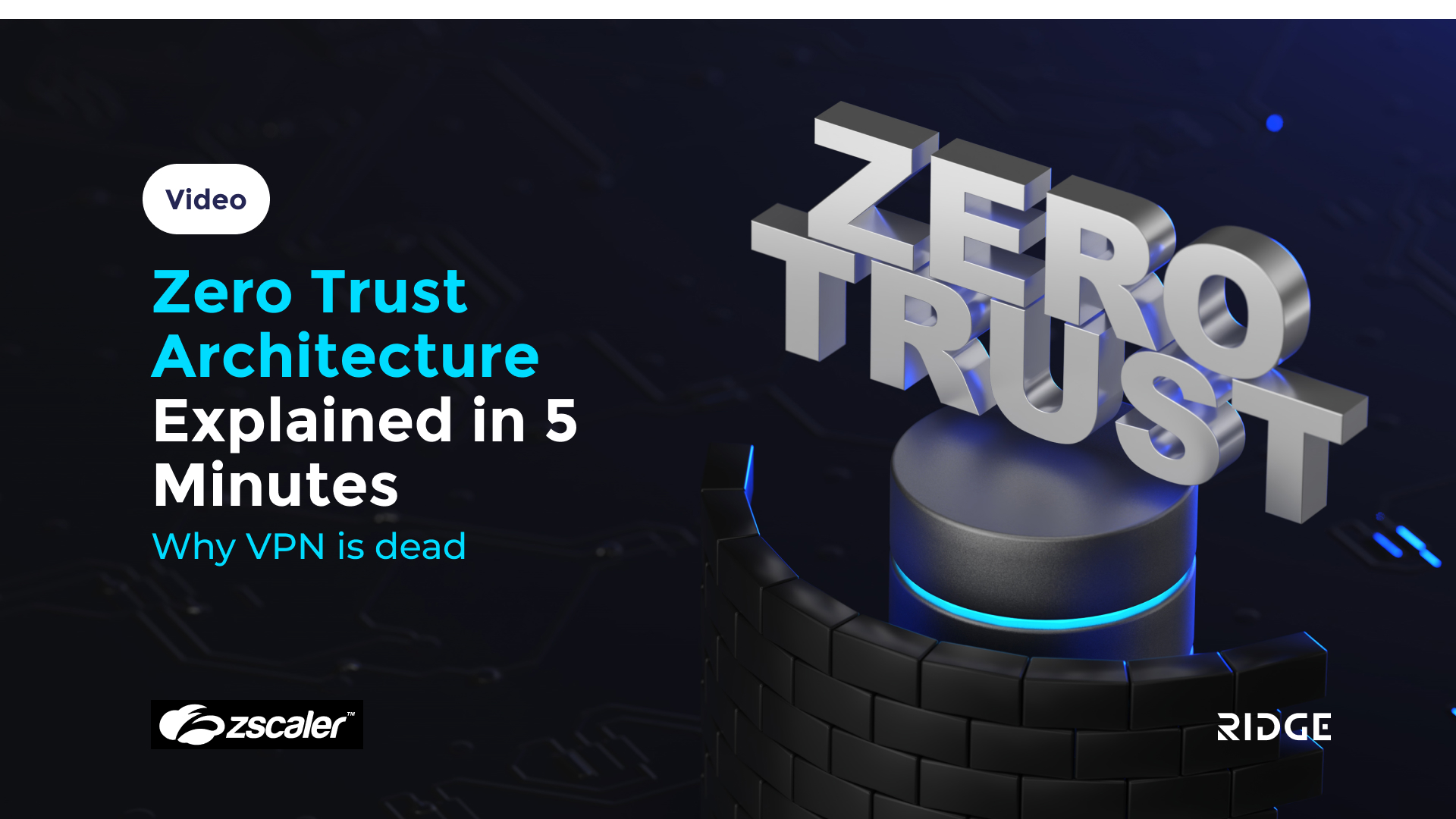
Zero Trust Architecture Explained: Why VPN Is Dead (And What Replaces It)
A plain-English 5-Minute breakdown for IT and cybersecurity decision-makers | Powered by Zscaler Zero Trust Exchange
If your organization is still relying on a VPN to connect remote users to internal applications, you have a problem — and the attackers already know it. Zero trust architecture is the modern security model that eliminates the fundamental vulnerabilities that VPN was never designed to address. In this post, we break down exactly what zero trust means, why VPN always falls short, and how the Zscaler Zero Trust Exchange makes “you can’t attack what you can’t see” a technical reality.Quick Answer
What is Zero Trust Architecture?
The Core Problem with VPN: If You Can Reach It, You Can Breach It
Traditional VPN architecture places a concentrator — usually in the data center — that waits for incoming connections from remote users. On its own, that sounds functional. The problem is that same concentrator is also reachable by the anonymous internet. It’s a publicly exposed attack surface sitting at the edge of your most sensitive infrastructure.
Here’s what happens the moment a user authenticates through VPN:
- They are placed on the network — not just granted access to one application
- Without strict segmentation, they can communicate with any asset on that network, including databases, branch offices, factory floors, and OT systems they have no business touching
- Tools like NMAP let any authenticated user scan the entire network and enumerate every application, IP, and open port
- If a threat actor compromises that user’s credentials, they inherit the same lateral movement capability
This isn’t a configuration flaw. It’s a fundamental architectural flaw. VPN was designed for a world where the perimeter was the security model. That world no longer exists.
Key Stat
What Zero Trust Architecture Actually Does Differently
Zero trust architecture operates on a fundamentally different premise: keep users off the network entirely. Access is not granted to a network — it is granted to a specific application, for a specific user, at a specific moment in time, after verification passes.
The Zscaler Zero Trust Exchange model executes this through three key mechanisms:
The Agent: Redirecting Traffic Away From the Network
A lightweight agent on the user’s device has one job: route all traffic to the Zscaler cloud platform — the Zero Trust Exchange — rather than to a VPN concentrator or the corporate network. The user never touches the network directly.
Inside-Out Connectivity: Dark by Default
Instead of opening inbound ports that the internet can probe, a lightweight Zscaler connector VM is deployed near internal applications. This VM reaches outbound to the Zero Trust Exchange — it never listens for inbound connections. The result: your internal applications are completely dark to the internet. They have no IP addresses exposed. You can’t attack what you can’t see.
This is the technical foundation of Ridge IT’s “going dark” security philosophy. Zscaler’s inside-out architecture is what makes that promise operationally real — not just a marketing tagline.
Policy Enforcement at the Exchange — Always
Policy is never enforced at the endpoint agent or at the connector VM. It is always enforced in the Zero Trust Exchange. This means segmentation is centrally controlled, auditable, and consistent — regardless of where the user is, what device they’re on, or which cloud the application lives in.
Zero Trust vs. VPN: Side-by-Side Comparison
| Capability | Legacy VPN | Zero Trust Architecture |
|---|---|---|
|
Attack surface |
VPN concentrator publicly exposed |
Applications dark; no inbound ports |
|
Network access |
User placed on the full network |
User connects to app only — not network |
|
Lateral movement |
Unrestricted without segmentation |
Blocked by default — no network adjacency |
|
Identity verification |
One-time at login |
Continuous — every session, every request |
|
NMAP / recon |
Entire network enumerable |
No visible assets to enumerate |
|
Policy enforcement |
Firewall rules, often inconsistent |
Centralized in Zero Trust Exchange |
|
Scalability |
Concentrator hardware limits |
Cloud-native, scales automatically |
How Threat Actors Think — And Why Zero Trust Breaks Their Playbook
Modern adversaries follow a predictable kill chain: get in, move laterally, find credentials, exfiltrate data. VPN architecture was purpose-built to help users move around the network. Unfortunately, it’s equally effective for attackers.
Zero trust architecture breaks each step of that playbook:
- Can’t get in: Applications are dark. There’s no publicly routable surface to probe or exploit.
- Can’t move laterally: Users are never on the network. Even a fully compromised endpoint cannot pivot to adjacent systems.
- Can’t enumerate assets: NMAP sees nothing. Application discovery through network scanning becomes impossible.
- Can’t exfiltrate at scale: SSL inspection and DLP at the Zero Trust Exchange catches data leaving the environment, even over encrypted channels.
This is why forward-looking security organizations — particularly those operating under CMMC, NIST 800-207, and Executive Order 14028 mandates — are treating zero trust architecture not as a nice-to-have, but as a compliance and operational baseline.
Access Your Internal Applications Like You Access Microsoft 365
Here’s the practical mental model for zero trust network access: think about how you access Microsoft 365 or Salesforce. You don’t connect to a network to use those apps. You authenticate with your identity, and the application is simply available. Posture, context, MFA — all verified before you get in. You are never on Microsoft’s internal network.
That is exactly how zero trust architecture treats every internal application — your ERP, your file shares, your custom line-of-business applications. Identity authorization plus device posture equals conditional access. No network. No VPN. No attack surface.
Ridge Advantage
Zero Trust Architecture
Frequently Asked Questions
How does Zero Trust identity management differ from traditional multi-factor authentication?
While Multi-Factor Authentication (MFA) verifies identity during login, Zero Trust security continuously validates access throughout the entire session. Advanced Identity Verification monitors user behavior, device compliance, and access patterns to detect anomalies that traditional MFA would miss. This prevents attackers from maintaining persistence after initial compromise.
What is Zero Trust Architecture in simple terms?
Zero Trust Architecture in simple terms is a security model where no user, device, or connection is trusted by default — regardless of whether it's inside or outside the corporate network. Every access request must be verified against identity, device health, and context before being granted, and only to the specific resource requested.
Why is VPN not Zero Trust?
VPN not Zero Trust — the reason is architectural. VPN places authenticated users onto the corporate network, granting broad access rather than application-specific access. It creates an exposed attack surface, enables lateral movement, and allows network-wide enumeration. Zero trust architecture, by contrast, keeps users off the network entirely and makes applications invisible to the internet
Going dark cybersecurity: What does It mean in Zero Trust
Going dark cybersecurity means making your entire infrastructure invisible to the public internet — no exposed IP addresses, no listening ports, no discoverable attack surface. Using Zscaler's inside-out connectivity model, internal applications become completely unreachable unless a user has been verified through the Zero Trust Exchange, eliminating the attacker's ability to perform reconnaissance entirely.
What is zero trust employee off-boarding and how does it work?
Zero trust employee off-boarding is the process of immediately revoking all system access when employees leave your organization. Unlike traditional security models, it eliminates security gaps through identity-based access control.
When you disable a departing employee's account, zero trust employee off-boarding instantly revokes access to:
- All cloud applications (Microsoft 365, Salesforce, etc.)
- On-premises systems and databases
- Email and collaboration tools
- File shares and storage
- VPN and network resources
Traditional off-boarding often leaves former employees with lingering access through forgotten systems, shared credentials, or cached authentication tokens. We prevent this by requiring continuous identity verification for every access request—no valid identity means zero access across your entire environment.
The advantage: Complete access termination in seconds, not days or weeks.
Our protocols ensure clean separation, CMMC compliance for DoD contractors, and elimination of insider threat risks from departing personnel.
What is AI Zero Trust identity verification and how does it work?
AI Zero Trust identity verification transforms static authentication into continuous, adaptive security by analyzing user behavior patterns, device posture, access context, and threat intelligence in real-time to assign dynamic trust scores. By 2028, 60% of Zero Trust tools will incorporate AI capabilities including behavioral biometrics (keystroke patterns, mouse movements), anomaly detection, automated policy enforcement, and predictive threat identification—enabling organizations to detect compromised credentials before attackers can exploit them.
AI-powered identity verification continuously monitors sessions rather than just validating at login, automatically adjusting access permissions when detecting unusual activities like impossible travel, abnormal data access patterns, or suspicious application usage. This adaptive approach reduces false positives while catching sophisticated attacks that bypass traditional MFA. Ridge IT's AI-enhanced Zero Trust implementations leverage machine learning to create unique behavioral profiles for each user, automatically blocking access when deviations occur.
How does Zero Trust scalability adapt to business growth?
Zero Trust scalability enables business expansion through cloud-native architecture that automatically adapts to increasing users, locations, and devices without infrastructure overhauls. Unlike traditional VPNs that become exponentially complex, scalable Zero Trust architecture uses identity-based access controls and micro-segmentation that grows linearly with your operations—which is why 81% of organizations are adopting Zero Trust by 2026.
When businesses expand through acquisitions, remote workforce growth, or multi-cloud migrations, Zero Trust scales through centralized policy management extending automatically to new assets. Organizations achieve 40-60% cost reductions while supporting growth from 50 to 5,000+ employees without performance degradation. Ridge IT's cloud-based Zero Trust implementations include automated provisioning and continuous verification that adapts to your expansion timeline.
How does Zero Trust IAM integration work with existing identity systems?
Zero Trust IAM integration works seamlessly with existing identity management systems including Active Directory, Azure AD, Okta, Google Workspace, and legacy IAM platforms through native connectors and API-based integrations. Rather than replacing your current infrastructure, Zero Trust architecture extends existing identity systems with continuous verification, context-aware access controls, and behavioral analytics—which is why 60% of enterprises implement Zero Trust principles by overlaying them onto established IAM frameworks rather than rebuilding from scratch.
Modern Zero Trust solutions integrate with multiple identity providers simultaneously, enabling unified policy management across cloud, on-premises, and hybrid environments without migration disruption. Organizations typically achieve integration within 4-8 weeks while maintaining existing authentication workflows for end users. Ridge IT Cyber's Zero Trust implementations connect with your current IAM systems including SAML, OAuth, and LDAP protocols, adding micro-segmentation and real-time risk assessment without requiring credential migration.
How does Zero Trust identity management affect user experience?
Properly implemented Zero Trust actually improves user experience by enabling seamless access to authorized resources while eliminating security friction for legitimate users. Users experience fewer security prompts and faster access to approved applications while maintaining stronger protection.
What’s the ROI of implementing Zero Trust identity management?
Organizations typically see significant reductions in security incidents, faster incident response times, and substantial cost savings from prevented breaches. Comprehensive Zero Trust implementation costs significantly less than the potential expenses of major security incidents.
How long does Zero Trust identity implementation typically take?
The timelines for Zero Trust identity management implementation vary based on organizational complexity, but phased approaches typically achieve initial protection within 30 days and comprehensive coverage within 90 days. Critical systems receive protection first, with gradual extension to all resources while maintaining business continuity.
How does CMMC affect my existing NIST compliance?
CMMC enforces NIST SP 800-171 and 800-172 requirements through verification. Review our NIST compliance guide and see how our Zero Trust architecture streamlines both frameworks.
What makes identity-centric security the most effective control point?
Identity-centric security provides the most comprehensive view of access across diverse environments, ensuring protection regardless of network location, device, or platform. Zero Trust Identity Management enables granular control over permissions and leverages advanced authentication to prevent unauthorized access. This approach reduces risks and adapts seamlessly to modern, distributed infrastructures unlike multi-factor authentication.
What makes your Zero Trust different from basic cyber security tools?
Most tools only check access once. Our military-grade platform verifies every action in real-time. We integrate identity, device, and behavior monitoring to stop threats other tools miss. Plus, you get 15-minute response times from the team that built your security.
How does Zero Trust handle third-party access?
Traditional VPNs give vendors too much network access. Our granular access controls tackles third-party risk by restricting vendors to only the specific resources they need. Combined with continuous monitoring, this prevents vendor credentials from becoming a security liability.
Can Zero Trust work with cloud infrastructure?
Our Zero Trust architecture is cloud-native by design. We use automated cloud security controls to protect resources whether they're on-premises or in the cloud. This lets you migrate safely to hybrid environments while maintaining consistent security.
What’s the connection between Zero Trust and CMMC compliance?
Zero Trust is the foundation of CMMC 2.0 requirements. Our military-grade implementation automatically satisfies key CMMC controls around access management and continuous monitoring. Using our ONE Platform, you get both robust security and documented compliance.
How do you implement Zero Trust without disrupting operations?
How do you handle disaster recovery in the cloud?
Unlike basic backups, our managed IT implements automated failover across regions. Our multi-region architecture maintains business continuity with 15-minute recovery times and zero data loss, while automated testing ensures your recovery plan actually works.
What security controls protect our data in the cloud?
Our managed IT implements military-grade security from day one. Through Zero Trust architecture, we protect cloud workloads with continuous monitoring, encryption, and automated threat response - maintaining compliance while enabling scalability.
What makes Zero Trust architecture worth the investment?
Traditional security assumes everything inside your network is safe - that's why 94% of breaches start with compromised credentials. Our managed IT implements Zero Trust to verify every access request, reducing your attack surface by 90%. By preventing lateral movement through segmentation and continuous monitoring, we stop basic breaches from escalating into six-figure disasters.
Do subcontractors need CMMC Certification?
Yes, but our unique approach can help. While flow-down typically requires matching certification levels, our subcontractor compliance guide explains how our Zero Trust architecture can eliminate this requirement.